
Kitchen drawers are where organization goes to die.
You start with good intentions. Spatulas in one spot, measuring spoons in another. Then one random Tuesday you are elbow-deep in a drawer hunting for a can opener while something burns on the stove and you cannot find it because it is underneath three rubber bands, a takeout menu, and a chopstick from 2018.
Most kitchen drawers are not disorganized because the person using them is lazy. They are disorganized because there was no real system to begin with, just stuff put in a drawer with a vague intention of sorting it later.
This post covers how to fix that properly, not with a shopping list, but with a system that works in any kitchen.
Why Kitchen Drawers Get Messy So Fast
Kitchen drawers have one thing working against them from the start: they are easy to close.
A messy countertop bothers you because you see it. A junk drawer gets closed and forgotten until the next time you need something that is buried in it. The friction of opening and closing a drawer hides the problem right up until the moment it becomes annoying enough to deal with.
The second issue is lack of ownership. Most drawers in a kitchen are not assigned a specific purpose. They are just “the drawer near the stove” or “the one with the stuff in it.” Without a clear definition of what goes where, everything ends up everywhere.
Step 1: Pull Everything Out Before You Do Anything Else
Every organized drawer starts with an empty one.
Take everything out of every kitchen drawer at once and put it on the counter or kitchen table. All of it. Yes, this makes a mess before it makes things better. That is fine.
Now you can actually see what you have. Most people discover three things at this stage:
Duplicates. Two can openers. Four sets of measuring spoons. Three vegetable peelers. Pick the best one of each and set the rest aside to donate or discard.
Things that do not belong in a kitchen drawer. Phone chargers, pens, takeout menus, keys, medicine, paperwork. These go to their actual homes now, not back into the drawer.
Things you forgot you had. Gadgets bought once and used zero times since. A garlic rocker. A cherry pitter. An avocado slicer. Be honest about whether you actually use these. If you cannot remember the last time you used something, it probably goes.
The goal at this stage is subtraction. The fewer things going back into the drawers, the better any organization system will work.
Step 2: Decide What Each Drawer Is For
Before anything goes back in, assign each drawer a specific job.
A typical kitchen with three to five drawers might be organized like this:
Drawer 1 (closest to the stove): Daily cooking tools only. The spatula, wooden spoon, tongs, ladle, and whisk you reach for several times a week. Nothing else.
Drawer 2 (near the prep area): Knives, peeler, grater, scissors, and prep tools used regularly. Or if you have a knife block, this becomes the measuring and baking tools drawer.
Drawer 3 (under the counter or farther away): Less-used tools. The pastry brush, the apple corer, the pizza cutter, the rolling pin. Things you reach for occasionally rather than daily.
Drawer 4 (if you have one): The junk drawer, managed. Every kitchen has one and fighting this fact is a losing battle. Accept it, contain it, and give it a limit: it fits what fits and nothing more.
The exact assignments depend on your kitchen layout and cooking habits. The rule is simply this: every drawer has one defined category and items in that drawer belong only to that category.
Step 3: Use Dividers, But Only if You Need Them
This is where most organization advice immediately tells you to buy a specific organizer. Resist this for a moment.
Before spending money, check whether what you already own can do the job.
Small boxes and lids from food packaging, shoeboxes cut down to size, or small tupperware containers all work as drawer dividers. Line them up inside the drawer to create sections. They are free and often the right size for a specific drawer.
Rubber shelf liner cut into strips and folded into small L-shapes stops items from sliding around without any container at all.
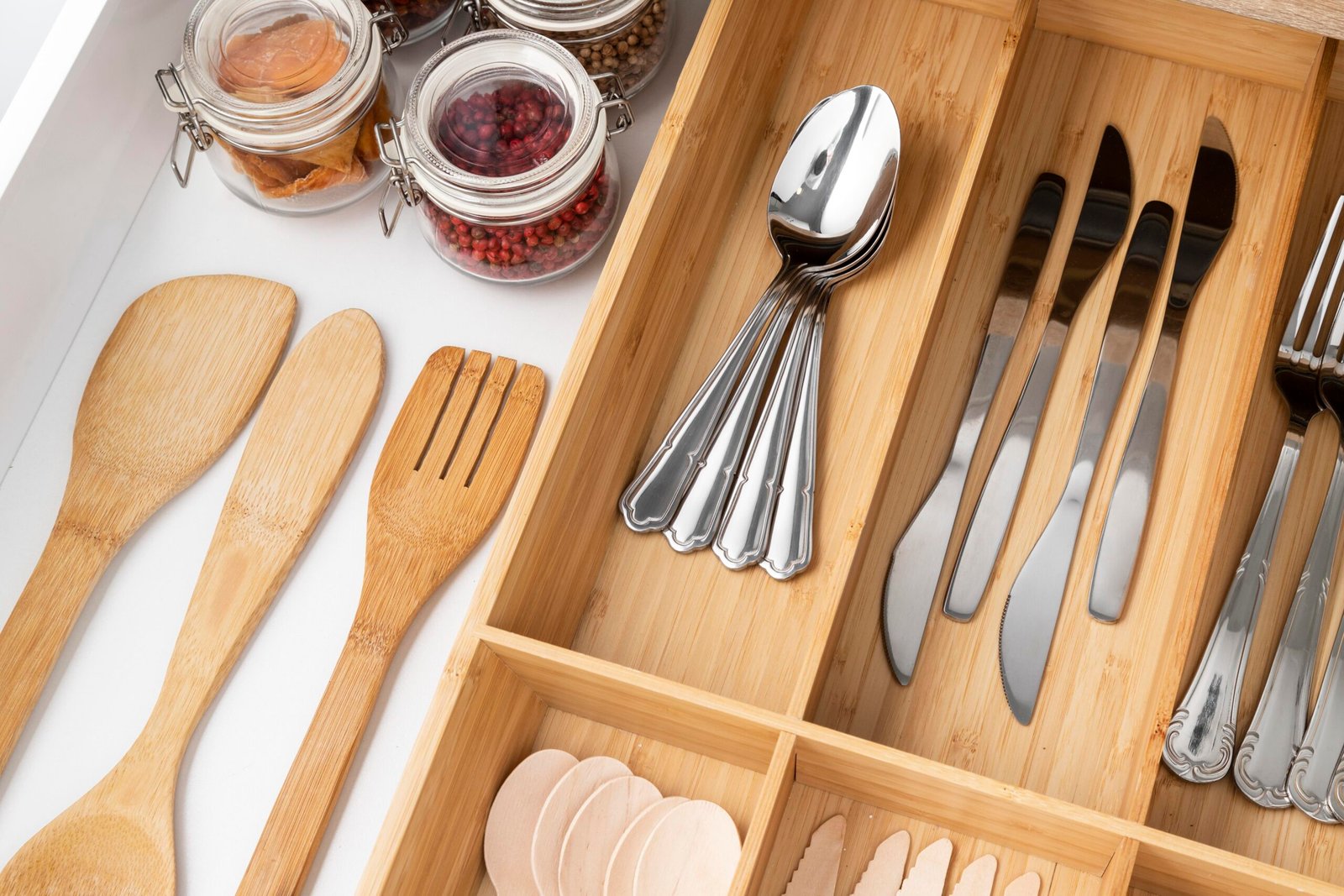
If after this check your drawers genuinely need proper dividers, bamboo adjustable drawer dividers are the most practical option. They adjust to fit any drawer width, cost very little, and last years. You do not need a custom insert for each drawer.
The standard to aim for: every category of item has its own section so you can locate it without moving other things out of the way.
The Junk Drawer: Keep It, But Control It
Every attempt to eliminate the junk drawer fails. Life generates small miscellaneous objects that do not have a permanent home and pretending otherwise just means they land on counters instead.
The goal is not to get rid of the junk drawer. The goal is to make it a managed junk drawer.
Set a size limit. The junk drawer fits what fits. When it gets full, that is the signal to spend five minutes clearing out what has accumulated. Not weekly, just when it reaches capacity.
Give frequent-use items a fixed spot within it. Batteries, a pen, scissors, and tape probably live in most junk drawers. Give these a small container each so they are always findable even when the rest of the drawer is in its usual chaos.
Purge once a month. Set a reminder. It takes three minutes. Pull out anything that has a real home elsewhere and put it there. Throw away anything expired, broken, or genuinely useless. The drawer resets without ever becoming truly organized, which is fine.
How to Keep Kitchen Drawers Organized Long Term
Getting drawers organized takes maybe two hours total. Keeping them organized takes one habit.
Put things back in their drawer after washing. Not in whichever drawer is closest. In the right one.
This sounds obvious. But the single reason organized drawers fall apart over weeks and months is that items get put back in the wrong place during busy moments. Three months of small wrong placements and the system dissolves.
The fix is making the right place slightly easier to use than any wrong place. When the daily cooking tools drawer is right next to the stove, returning the spatula to it is easier than putting it anywhere else. Good organization removes the friction from doing the right thing.
If a drawer keeps pulling items from other drawers, that is useful information. It means the categories are slightly wrong for your actual habits. Adjust the categories rather than fighting your own patterns.
Quick Reference: Which Items Go in Which Drawer
Daily cooking drawer: Spatula, wooden spoon, silicone spoon, tongs, ladle, whisk, slotted spoon.
Prep tools drawer: Chef’s knife, paring knife, scissors, vegetable peeler, grater, zester, bottle opener, can opener.
Baking and measuring drawer: Measuring cups, measuring spoons, pastry brush, rolling pin, bench scraper, skewers.
Occasional tools drawer: Pizza cutter, mandoline, apple corer, corn stripper, cherry pitter, any specialty gadget used less than weekly.
Managed junk drawer: Batteries, a pen, tape, rubber bands, a small screwdriver, spare buttons, and whatever else life generates.
Frequently Asked Questions
Q: What is the best way to organize kitchen drawers without buying anything?
Empty the drawer completely and sort what comes out into categories. Use small boxes, lids, and containers you already own as dividers. The organization comes from the sorting and the decision about what stays, not from the containers themselves.
Q: How do I organize a very small kitchen with very few drawers?
Prioritize the daily cooking tools in whatever drawer is closest to the stove. Everything else gets evaluated for frequency of use. Items used rarely can live in a higher cabinet or in a box on a shelf rather than taking premium drawer space. Vertical knife blocks and magnetic knife strips also free up drawer space significantly.
Q: Should I buy drawer organizers or make my own?
Try the free version first. Small boxes, cut-down packaging, and rubber shelf liner handle most drawer organization needs. If after trying this your drawers still feel chaotic, adjustable bamboo dividers are the most cost-effective purchase and work in almost any drawer size.
Q: How often do kitchen drawers need to be re-organized?
A well-set-up drawer system should only need a real re-organization once or twice a year. The junk drawer benefits from a quick five-minute reset once a month. If you find yourself reorganizing the same drawers repeatedly, the issue is usually that the category assignments do not match how you actually cook. Adjust those rather than starting over.
Q: What do I do with kitchen gadgets I never use but feel bad throwing away?
Put them in a box and set a date three months from now. If you have not needed anything in that box by the date, donate the whole box without reopening it. You have already proven that those items are not part of your actual cooking life.
Q: My family keeps putting things in the wrong drawer. How do I fix this?
Labels help more than most people expect, especially in shared kitchens. A small label on the front or inside edge of each drawer removes the guesswork for everyone using the space. It does not need to be a permanent label, a piece of masking tape with writing on it works fine while a new habit is forming.
For the full room-by-room approach to home organization beyond just the kitchen, the guide on how to organize a small home without buying more storage covers every room using the same principles.